We want to filter out all the noise, because I’m sure many of you have heard the clichés: that non-monogamous people are immature, that they don’t want to commit, or that they simply don’t want to take responsibility for their actions.
Well, let me tell you that these assumptions are not what defines a healthy non-monogamous relationship.
Of course, these relationships can go wrong. People can hurt you, break your trust, or even leave you for someone else. I’m not going to pretend otherwise. But if someone wants to replace you, they can do so regardless of the relationship structure you have.
The real question isn’t whether a relationship is monogamous or non-monogamous, but how the people involved treat each other.
Monogamy
Let’s start with a classic that most of you will already know.
Traditional Monogamy
This is the idealized version of monogamy: you are emotionally and romantically attached to your partner, and you never feel any attraction towards anyone outside your relationship.
Surprisingly, this ideal is unrealistic for many people. Being in love doesn’t necessarily make you blind to everyone else, and finding another person attractive doesn’t automatically mean you love your partner any less.
Now let’s focus on how monogamy works in practice.
Both people in a relationship can experience attraction towards others. However, they choose to remain together and respect the boundaries and agreements they have established.
The difference isn’t necessarily the absence of attraction, but what you choose to do with it.
Non-Monogamy
Now let’s talk about two of the best-known forms of consensual non-monogamy: open relationships and polyamory.
Open Relationships
As the name suggests, an open relationship allows its members to have sexual encounters with people outside their relationship.
However, romantic relationships with those people are generally outside the scope of the agreement. The focus is usually on allowing sexual freedom while maintaining a romantic partnership between the original partners.
Of course, every relationship is different, and the exact boundaries depend on the agreements between the people involved.
Polyamory
Polyamory is the possibility of having multiple romantic relationships with the knowledge and consent of everyone involved.
Unlike a typical open relationship, where outside encounters are often primarily sexual, polyamory allows people to develop emotional connections, fall in love, and build committed relationships with multiple partners.
That doesn’t mean that anything goes. Consent, communication, honesty, and mutually understood boundaries remain essential.
Depending on how these relationships are organized, we can distinguish between two broad approaches.
Hierarchical Polyamory
In hierarchical polyamory, some relationships have a higher priority than others.
For example, someone might have a primary partner whose relationship takes precedence when it comes to certain decisions, commitments, or shared responsibilities.
This doesn’t necessarily mean that other relationships are less meaningful. However, there is an acknowledged difference in priority, and that difference can influence how the relationships develop.
Non-Hierarchical Polyamory
In non-hierarchical polyamory, relationships aren’t automatically ranked according to a predefined hierarchy.
The people involved aim to avoid assigning partners a higher or lower status simply because of a label or relationship category.
However, this doesn’t mean every relationship will have the same impact, involve the same commitments, or receive exactly the same amount of time and attention. Different relationships can have different needs while still being valued in their own right.
Ultimately, the goal is to build relationships based on the needs, boundaries, and agreements of the people involved rather than following a predetermined ranking system.
Different Ways to Organize Non-Monogamous Relationships
As you can see, human relationships can have different members, shapes, and even flavours. Let’s explore some of the ways people can organize their relationships.
Throuple and Larger Groups
Let’s start with something relatively simple: a throuple.
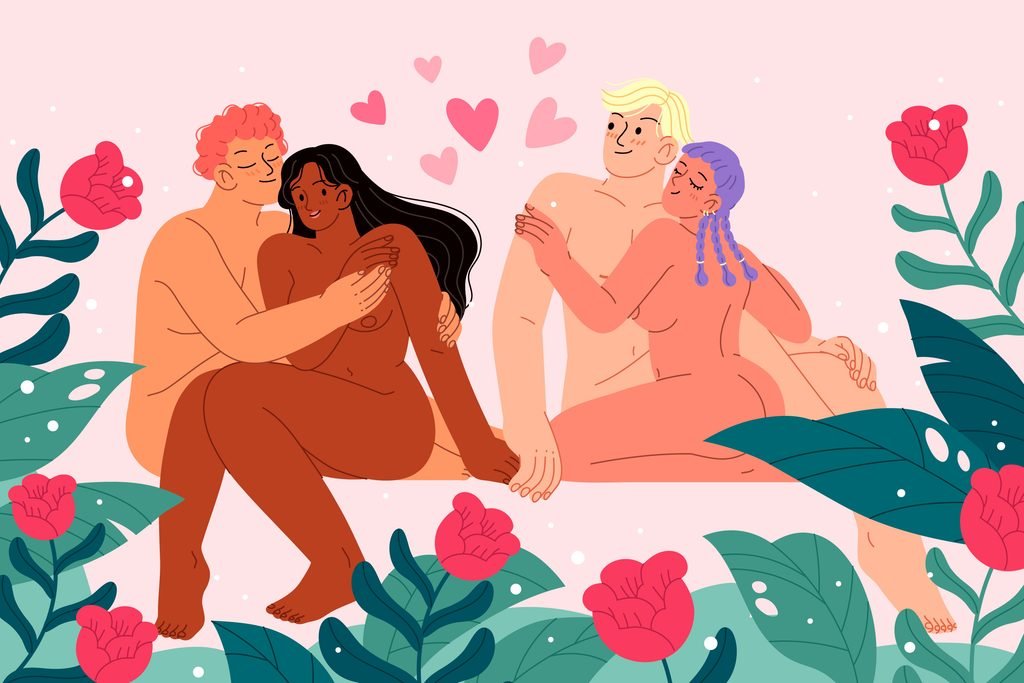
A throuple is a romantic relationship involving three people who are all romantically involved with each other.
Think of it as a network rather than a single relationship: people can be connected indirectly through their partners, creating a larger web of relationships. We can even call them constellation each member have their own system .
Solo Polyamory
Solo polyamory is an approach in which someone maintains multiple romantic relationships while prioritizing their independence and autonomy.
They might not want to live with a partner, merge finances, or follow the traditional expectation that relationships should progress towards cohabitation or marriage.
That doesn’t mean they avoid commitment or emotional intimacy. They can have deep, meaningful, long-term relationships without making a single partner the center of their life.
Different Structures, Different Needs
These examples show that non-monogamy doesn’t follow a single blueprint.
Some people prefer a closed group, others prefer relationships that develop independently, and some are comfortable being part of a wider network of connections.
None of these structures automatically determines whether a relationship is healthy, committed, or meaningful.
What matters is whether the people involved understand their agreements, respect each other’s boundaries, and can freely decide whether the arrangement works for them.
Also you don’t have to pretend you like a model if you are not comfortable with you can work your unsecurities even jelousy . But this type of relationships needs a lot of communication , honesty and taking care of others . So don’t force yourself for being in a place you won’t like to be on the future .